cVRP for utilities: everything you need to know

)


)
Direct Debit has been the default payment method for utility payments for decades. And it works — most of the time. But for billing teams managing variable charges, seasonal demand spikes, Ofgem price cap adjustments and persistent payment failures, "most of the time" carries a real operational cost.
But now there is a viable alternative for payment and digital product teams to consider: Commercial Variable Recurring Payments (cVRP) is now live, and utilities are one of the first sectors to access them. This article answers all the key questions on cVRP, how it works, its benefits, and how it compares to Direct Debit.
First, what exactly is cVRP?
VRP stands for Variable Recurring Payments. Built on open banking rails. But unlike single immediate payments, it adds a consent and mandate layer on top. This allows a business to collect several payments of varying amounts directly from a customer's bank account, under a single upfront authorisation.
There are two types. Sweeping VRP (sVRP) covers payments between two accounts belonging to the same person — credit card repayments, savings top-ups and similar. This has been live for several years.
Commercial VRP (cVRP) is what utility providers need: payments from a customer to a business, authorised once, then collected automatically within agreed limits.
At TrueLayer, we call the customer-facing experience Bank on File — deliberately echoing card-on-file, but powered by open banking rather than card networks. A customer links their bank once and gives consent for a business to collect future payments of varying amounts, without the consumer needing to initiate and approve each payment individually. Find out more about how Bank on File works.
Is cVRP available to use now?
Yes. Wave 1 of commercial VRP launched in early June 2026 under the UK Payments Initiative (UKPI), an industry body formed of 31 firms including all major UK retail banks. Utilities — covering energy, water and telecoms providers — are one of four explicitly in-scope sectors, alongside government, financial services and charity. VRP payments now account for approximately 7.4 million payments in the UK every month, up from 3.9 million 12 months ago.
How can utilities use cVRP?
Utility providers can use cVRP for several use cases, some of which mirror Direct Debit, while others are new use cases, or provide additional functionality to plug the gaps that Direct Debit lacks.
Variable monthly billing: a household's energy bill in January is obviously not the same as in July. With cVRP, the customer authorises a consent ceiling at the start of the relationship. You then collect the exact amount owed each billing cycle — no re-authorisation required when the amount changes, as long as it falls within that consent ceiling. Smart meter catch-up bills, mid-cycle adjustments and Ofgem price cap changes can all be handled without contacting the customer.
New customer onboarding: cVRP replaces the Direct Debit setup step with a fully digital journey — no paper confirmation, no email back-and-forth, no delay. With this real-time process, it means the first cVRP payment can take place immediately, unlike Direct Debit payments.
Managing seasonal demand: Consent parameters allow for an annual time period, with the maximum amount set to factor in seasonal changes in consumption across the year.
Ad hoc charges: engineer callout fees or one-off usage spikes sit comfortably within the same mandate, with clear payment references that separate them from the regular bill. Customers get visibility, and you avoid a separate, awkward billing process for irregular charges.
Debt collection: if a customer underpays for several months, which results in potentially hundreds of pounds of arrears, providers can use cVRP to create a repayment plan. Using confirmation of funds to maximise conversion (alongside active communication with the customer), the provider can set the parameter limits at an amount that matches the outstanding debt.
What are the benefits of using cVRP?
cVRP addresses specific, well-documented pain points of traditional methods like Direct Debit. Settlement is instant via Faster Payments rather than the three-day Bacs cycle. For large suppliers processing millions of transactions per month, the aggregate effect on working capital is significant — a material shift, not a marginal improvement.
Failure visibility is real-time. With Direct Debit, you discover a failed payment through the Automated Return of Unpaid Direct Debit (ARUDD) reporting cycle, typically three or more days after the event. With cVRP, the outcome is confirmed immediately, so recovery logic can fire the same day. That compressed window changes how you manage bad debt.
Lower operational cost follows naturally. No retry fees, no manual chase cycles, no reconciliation lag. No interchange or card scheme charges, either, because cVRP runs directly on bank rails.
The customer experience is also meaningfully better. Customers aren't surprised by unexplained re-authorisation requests when their bill changes. Their consent is visible through their bank app and cancellable at any time. For a sector where trust is hard won, that transparency has real value.

)
What does cVRP look like for your customers?
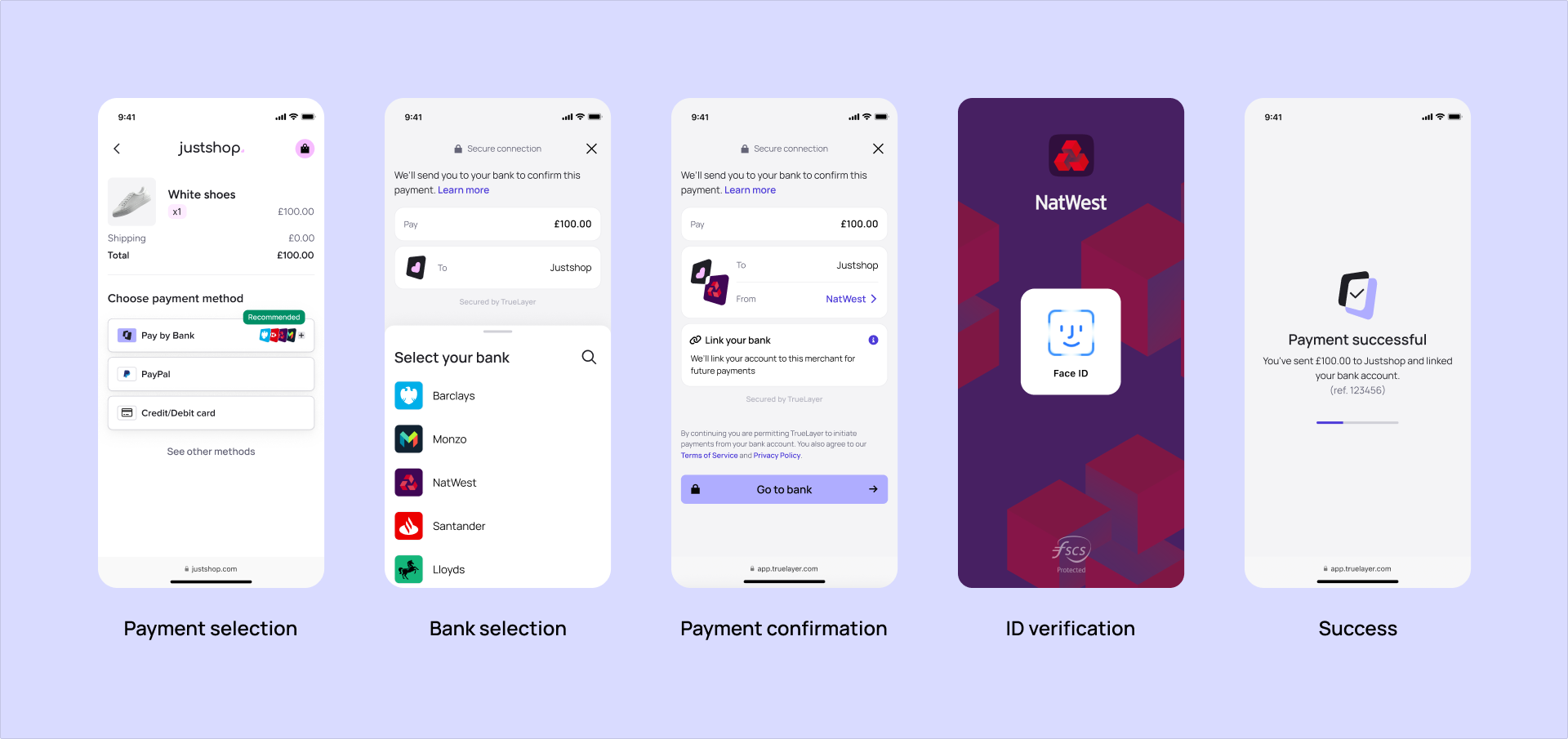
For the consumer, cVRP involves a simple set up experience:
At checkout, they select Pay by Bank (simple language like Link your bank will explain how this particular payment method works)
They select their bank from the list available
They are then sent to your bank account to securely authenticate the payment set up (where the exact consent parameters of future payments are clearly stated)
They are then sent back to the merchant, where their completed payment and bank linking is confirmed instantly.
For subsequent payments, the consumer doesn’t need to do anything, with the payment automatically collected as part of the pre-agreed consent parameters as set out in the initial payment set up.

)
cVRP vs Direct Debit for utility bills
Direct Debit is a proven, widely understood payment rail. It isn't going away overnight, and for utility providers it will remain part of the mix for some time — particularly while cVRP bank coverage continues to grow. But a direct comparison on the dimensions that matter most to billing teams shows how cVRP can compensate for the traditional challenges of Direct Debit:
| Feature | cVRP | Direct Debit |
|---|---|---|
| Settlement | Instant (via Faster Payments) | 3 working days (via Bacs) |
| Failure visibility | Real-time, with pre-emptive visibility on payment failures thanks to confirmation of funds | Automated Return of Unpaid Direct Debits (ARUDD), can take 3+ working days |
| Confirmation of funds | Yes, funds checked before initiating | Not available |
| Mandate set up | Fully digital | Paper or email confirmation steps still common |
| Failed payment recovery | Same-day recovery logic possible | Dependent on ARUDD reporting cycle |
The variability problem is where the gap between the two methods is most stark. Direct Debit handles variable billing through a fixed mandate with supplementary adjustments — and when amounts change significantly, the process can require a new mandate or formal customer notification. For a utility provider dealing with seasonal swings, Ofgem price cap changes and smart meter catch-up billing all at once, that creates real operational overhead.
Under cVRP, the consent ceiling handles variability by design. Utility providers collect the actual amount owed each month, within the parameters the customer already agreed to, with no additional steps. When a payment fails, you know immediately rather than days later — and you can act on it before the customer even notices there was a problem.
The practical starting point for most utility providers is a hybrid model: cVRP for new customers coming through digital onboarding, and for existing customers whose banks are already cVRP-enabled, with Direct Debit continuing for the remainder. As bank coverage grows and more customers move through cVRP-first journeys, the balance will shift automatically. The operational overhead of running both in parallel is low; the long-term benefit of building cVRP capability now is significant.
What is confirmation of funds?
Confirmation of funds is the ability to check whether a customer has sufficient balance in their account before initiating a payment. It doesn't eliminate failures — a customer with genuinely insufficient funds won't pay regardless — but it removes the category of failures that occur when a payment attempts to execute against an account that cannot clear it on that specific day.
For utility providers, this matters most during the months when bills are highest and customer cash flow is most constrained: winter, post-price cap rises, periods of peak energy consumption. Confirmation of funds lets you time payment attempts more intelligently, reducing failed collections before they happen rather than chasing them after. This capability isn't available with Direct Debit.
| Parameter | What it means | Example |
|---|---|---|
| Maximum amount per payment | The maximum amount a merchant can collect in a single payment | £50 |
| Maximum amount per time period | The maximum amount a merchant can collect during a pre-defined time period | £250 |
| Time period | The period of time in which the maximum amount per time period is applied | Weekly |
| Expiry Date | The date the current consent ends | 30 November 2026 |
What are consent parameters?
When a customer authorises a cVRP mandate, they agree to a set of explicit limits. These consent parameters define the maximum amount of a single payment, the maximum total that can be collected in a given period (typically per month), and the validity window for the consent overall.
Within those parameters, you collect without further customer involvement. In practice, utility providers would set the ceiling at a level that covers peak usage — high enough to accommodate seasonal spikes, but not so high that customers hesitate to authorise it.
Customers retain full control throughout. They can view the mandate, amend the parameters or cancel entirely, all through their bank app. That visibility is part of why cVRP tends to generate less customer friction than mandates that appear opaque.
Key terms explained
VRP (Variable Recurring Payments): a payment method allowing businesses to collect recurring payments of varying amounts from a customer's bank account, with one upfront authorisation.
cVRP (Commercial VRP): payments from a customer to a business. The type relevant to utility providers.
sVRP (Sweeping VRP): payments between two accounts belonging to the same person. Already live and widely used.
Wave 1: the first phase of commercial VRP rollout, covering utilities, government, financial services and charity. Launched June 2026.
UKPI (UK Payments Initiative): the 31-firm industry body, including all major UK retail banks, that operates the commercial VRP scheme.
Bank on File: TrueLayer's name for the customer-facing recurring payment experience built on VRP.
Mandate / consent: the customer's upfront authorisation of a cVRP arrangement, including all agreed consent parameters.
Confirmation of funds: the ability to verify a customer has sufficient balance before initiating a payment.
Faster Payments: the UK real-time payment infrastructure cVRP runs on, enabling instant settlement.
ARUDD: Automated Return of Unpaid Direct Debits — the Bacs reporting cycle through which Direct Debit failures are notified, typically three or more days after the event.
Taking the next step with cVRP
TrueLayer's Bank on File product is built on top of cVRP and already processes over 60% of all VRP transactions in the UK. If you're exploring what a cVRP billing experience could look like for your customers, speak to one of our payments experts.
)

TrueLayer and SumUp partner to simplify account top-ups across Europe
)

Chargebacks: the wrong design choice for Pay by Bank
)