)


)

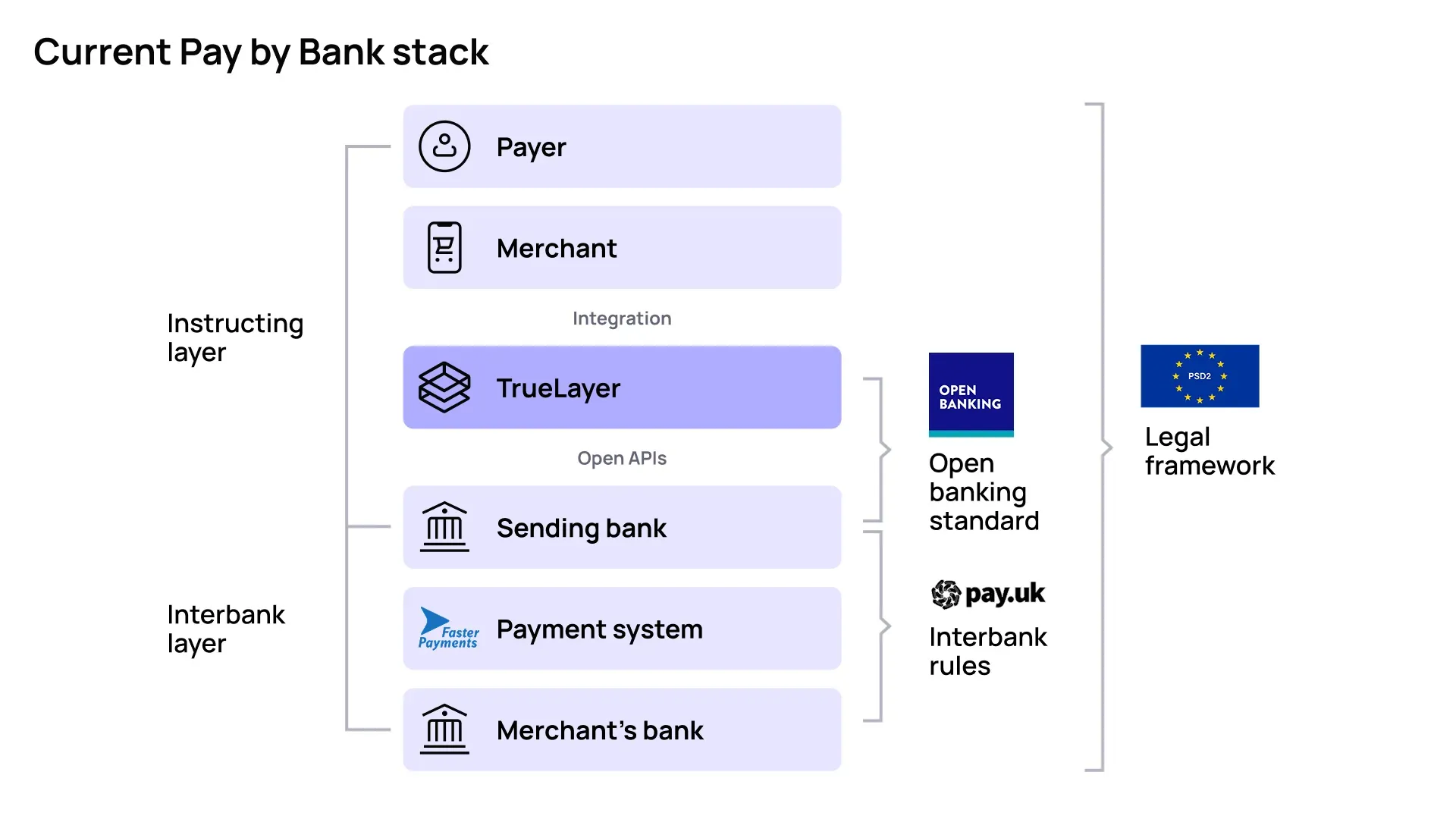
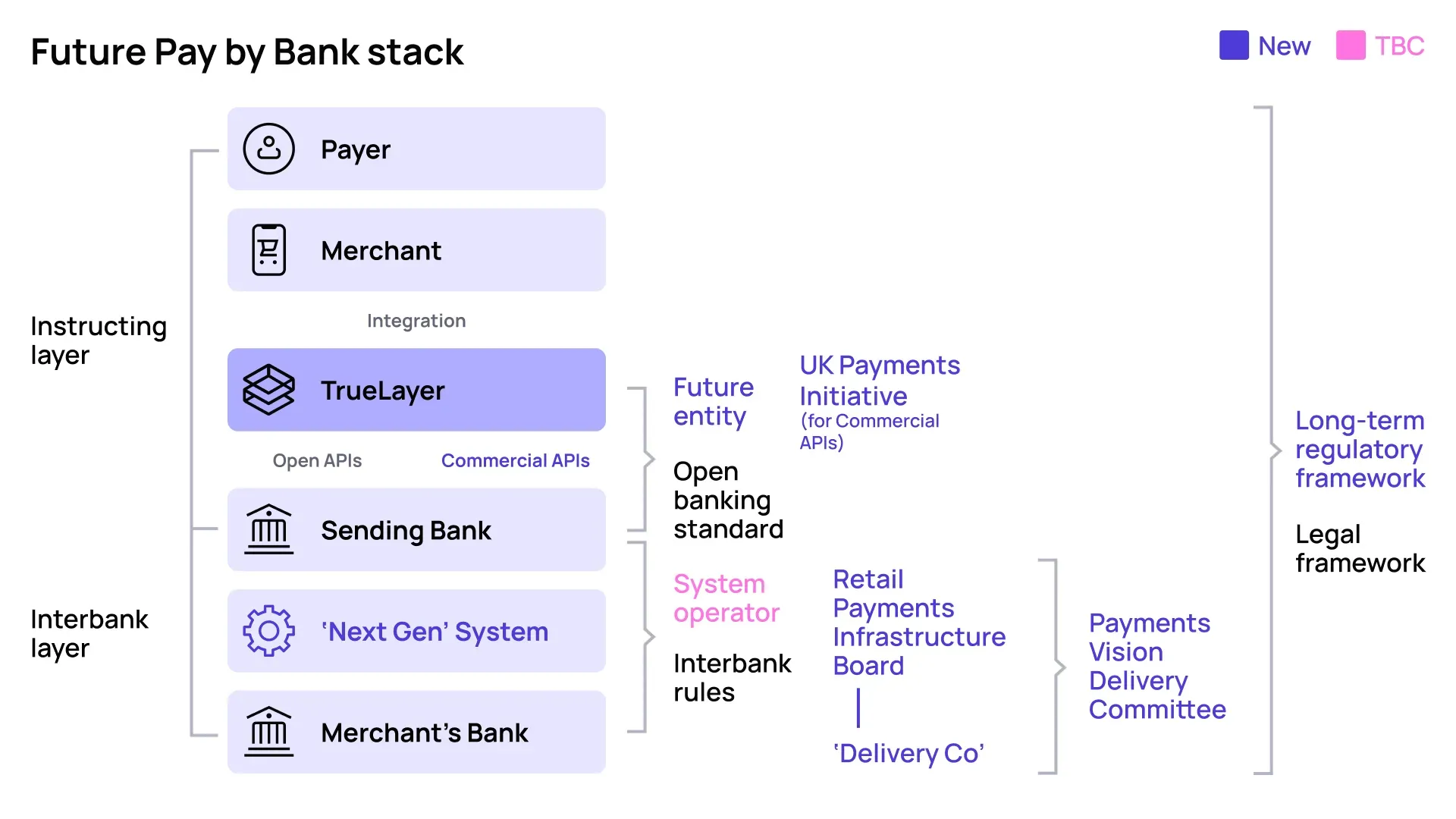
Payments in the UK are undergoing change at every level, across infrastructure, regulation and the future of open banking. Here's what's happening:
Infrastructure
The Bank of England is overseeing a process of replacing the UK’s aging inter-bank payment systems, including Faster Payments, introduced in 2008, with ‘next generation’ payment infrastructure. Every payment TrueLayer initiates goes from consumer to merchant via Faster Payments. We want the replacement infrastructure to deliver more payment certainty for merchants, and lower processing costs than today. The Future Retail Payments Infrastructure should be a platform for innovation. As a member of the Bank of England's Retail Payments Infrastructure Board (RPIB), we’re closely involved in these developments.
Regulation
The Treasury has kicked off reform of the UK’s overarching payments regulation, inherited from the EU, just as PSD3 is about to be finalised in Brussels. We support the Treasury’s proposal to apply the same ‘right of access’ for variable recurring payments that enables the rest of open banking today. But we think proposals about changing the economic model for open banking need to be carefully considered. We will be responding to the Treasury’s Modernising Payments Legislation review shortly.
Open banking
The standards body (Open Banking Limited) overseeing the bank APIs that make Pay by Bank possible is being transitioned into a new ‘future entity’, with the FCA having new powers over this body under the Data Use and Access Act. We support the creation of a strong successor body to Open Banking Limited, which can take a lot of the credit for making the UK a world leader in open banking. Its successor must have the same ability to push through change, monitor implementation and publish data on open banking, and eventually open finance take-up.
These changes shouldn’t be seen in isolation. Together they have huge significance for payments, especially Pay by Bank. This article discusses the first of these three major changes, and our response to the Bank of England’s consultation on the Future Retail Payments Infrastructure.
)
)
What was our response to the Future Retail Payments Infrastructure (FRPI) Consultation?
Deliver the ‘high-speed rails’ for ‘high speed trains’
We support the focus of the consultation being on the core clearing and messaging layer. We agree this is the crucial layer, on which everything else can build. Over the last ten years, TrueLayer has built a market leading Pay by Bank product on this layer, enabling account to account (A2A) payments for some of the biggest merchants in the world. We are able to innovate successfully today based on instructing Faster Payments via APIs, but are excited about the opportunity of Faster Payments being replaced by a more cost efficient, functional and optimised system. This would in effect, deliver the high speed rails to fully realise the potential of TrueLayer's high-speed train.
Enable open banking and Pay by Bank
As a company which relies on open banking APIs to provide our services, we are also pleased to see the consultation’s focus on ‘translating the public policy objectives of the National Payments Vision…. into a design for next-generation infrastructure’. The National Payments Vision mentions open banking 60 times, and commits to the development of Open Banking to drive delivery of seamless, A2A payments. We believe that Pay by Bank (an open banking-enabled A2A payment method) can become a ubiquitous alternative payment method, if the right changes are made at the core clearing and messaging layer.
Our four key ‘asks’ for the FRPI
Our key asks for the Future Retail Payments Infrastructure is that it is:
1. Commercially sustainable: low unit costs for instant payments
Unit infrastructure costs for the use of the UK real-time payment system are currently high, relative to some important international comparators. For example:
| Payment system | Unit cost | FPS fee multiple (FPS fee : other system fee) |
|---|---|---|
| Faster Payments (FPS) | £0.01042* | - |
| SEPA SCT Inst | €0.001-€0.002** | 6x-12x |
| PIX | BRL0.01 per 10 transactions*** | 72x |
Cost efficiency and sustainability should be explicitly included as a design principle for the FRPI. If the FRPI was to deliver equivalent or higher infrastructure costs for instant payments than currently available through Faster Payments, in our view this would be a significant failure and not supportive of policymaker ambitions for A2A payments.
2. Supports open banking payments: ‘Pay by Bank’ both online and at physical point of sale (PoS)
TrueLayer strongly supports the inclusion of A2A at point of sale as a priority and emerging payment journey to be supported by the FRPI. We agree that many elements of A2A at point of sale propositions (such as scheme rules) are best delivered by product level arrangements and schemes (such as UK Payments Initiative, who are already highly active in this space), but that some elements will require support at the central infrastructure level. Beyond delivering an enhanced core instant payment clearing and settlement functionality, we agree with the consultation position that areas where the FRPI has a role to play are:
Enabling greater certainty of fate in retail payment journeys
Supporting integration and support in the UK PoS ecosystem, on both the merchant (i.e. PoS terminals) and consumer side (e.g. support with NFC enablement from mobile phones).
3. Supports ecommerce and retail use cases: including with ‘certainty of fate’
Card payments enable businesses to instantly ship goods and services, because as soon as a card taps a terminal or customer clicks buy, an authorisation code is sent to the merchant in milliseconds, confirming whether or not a payment has been successful and, if so, the payment is then guaranteed to the merchant (albeit, the money settles in the merchant’s account some time later).
Faster payments initiated by open banking have no equivalent of an authorisation code or payment guarantee. A business has to wait for payments to settle in their account before they have the certainty to ship goods. While the majority of open banking payments are processed in seconds, in some cases, they can take hours or days — such as when a bank is holding a payment for investigation.
The FRPI must address A2A payment payment certainty, in order to enable competition with cards and allow A2A payments to become ubiquitous, per the National Payments Vision. This will need work by both the open banking API standards body and the operator of the FRPI on ‘certainty of fate’ messaging standards and protocols.
4. Supports direct access for non-banks: with proportionate initial and ongoing requirements for firms
Non-bank access to payment systems has long been an ambition of the Government and regulators, in order to promote competition and innovation. However, the process for accessing the payment systems, including the burdensome technical and governance obligations continue to create real barriers to such access. The FRPI must address these obstacles and barriers to non-bank direct access.
What’s next?
The Bank of England will be reviewing responses to its consultation, which will inform the final design of the Future Retail Payments Infrastructure. It has established an industry led Delivery Company to drive forwards the building phase, once the strategy and design is final.
We will be engaging closely on the infrastructure developments, as well as those at the regulation and standards level, to ensure Pay by Bank continues to grow strongly and compete in the UK.
*Pay.uk (2026) Faster Payments System Principles
**ECB TIPS fees of €0.001 and EBA Clearing RT1 fees of €0.002
)

The complete guide to commercial variable recurring payments (VRP)
)

cVRP explained: get up to speed on commercial variable recurring payme
)