
)


)
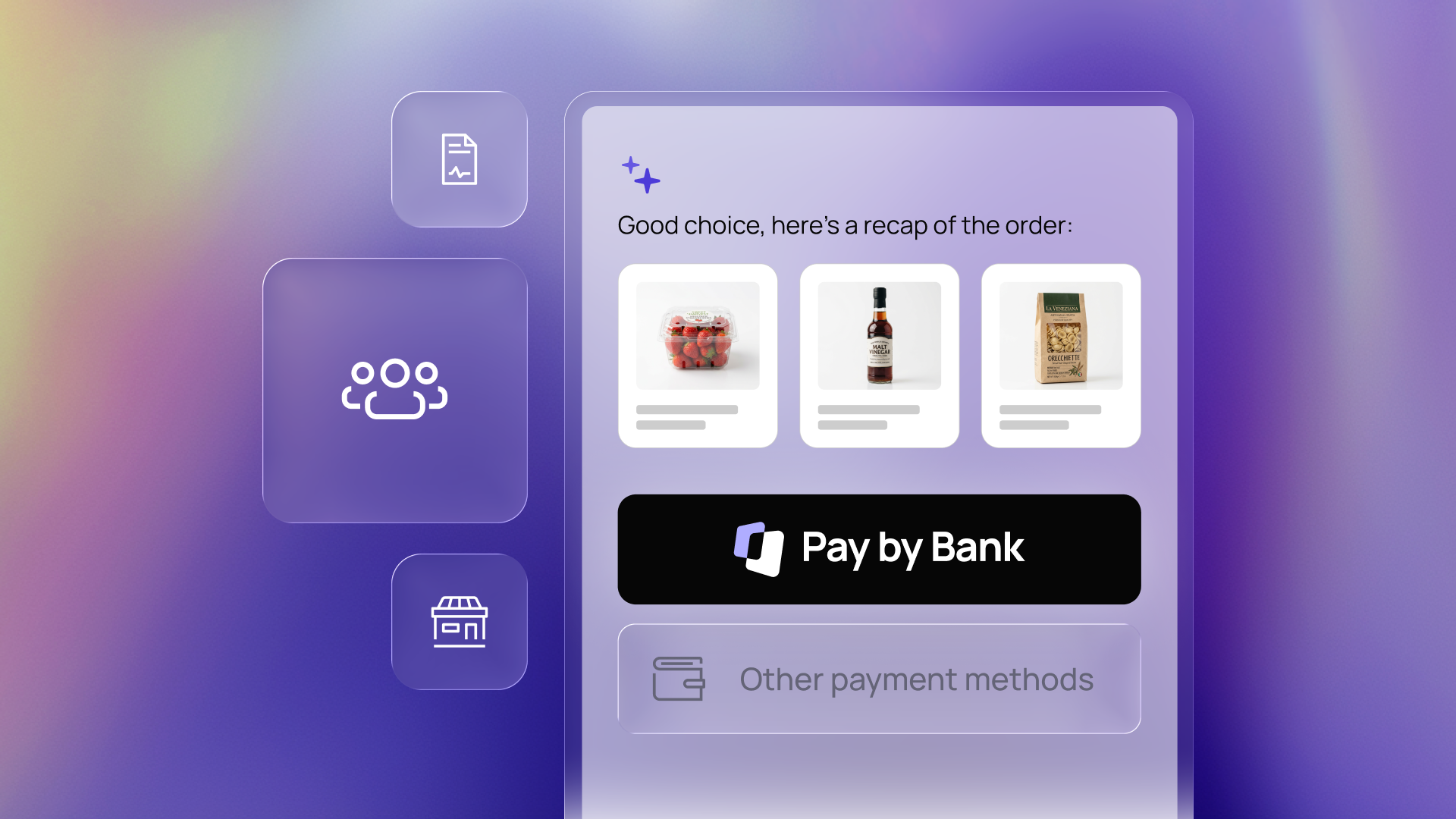
In the biggest signal yet that the UK Government is taking agentic payments seriously, the Financial Conduct Authority (FCA) announced the cohort of companies for its upcoming Supercharged Sandbox. 21 companies, including TrueLayer, will get the chance to develop and test advanced AI use cases, with a particular focus on agentic payments.
the more I talk about agentic commerce and agentic payments, the more I realise we’re all talking about it slightly differently. It’s clear that we, the payments industry, haven’t codified the agentic payment experience, the stages of the journey, the levels of automation.
This is my attempt to do exactly that. This area of payments is changing rapidly, and a shared language will help us talk about it more concretely. I also want to explore where Pay by Bank fits into this, because my colleague Megan Coulson has already talked about the danger of sleepwalking to card-based agentic payments by default.
The behavioural shift to AI-driven commerce has happened everywhere but payments
Looking at recent research from Adobe we can see that AI-driven traffic has grown dramatically across just about every industry. For example, in May 2026, retail sites saw 138% year-on-year growth in AI-driven visits and travel sites saw 194%..
But volume is only part of the story. Customers arriving via AI convert 54% higher and generate 53% more revenue per visit than other visitors. As models improve and suggestions become more relevant and personalised, people use AI assistants more for shopping and discovery. Trust builds over time, and as it grows, customers hand over more of the shopping journey to agents.
One part of the consumer journey remains untouched: the moment where you decide and then pay. Agentic commerce is designed to address exactly that. Where today you visit a website an AI assistant suggested and tap through checkout yourself, agentic commerce means delegating part (or all) of that journey to an AI agent acting on your behalf.
This changes how consumers choose and pay. Today, if I want to buy a new pair of trainers, I search for ones that suit my needs using an AI assistant. In the future of agentic commerce, I'll complete that entire journey through an agent, without visiting a merchant website at all.
| Action | Generative AI-assisted purchase journey today | The complete agentic commerce journey of the future |
|---|---|---|
| Research different pairs of trainers across different merchants | ✅ | ✅ |
| Research different pairs of trainers across different merchants Compare different trainers against criteria (arch support, weight, colour, price, size available etc.) | ✅ | ✅ |
| Shortlist options based on most important criteria | ✅ | ✅ |
| Decide which option to buy | ❌ | ✅ |
| Go to merchant, put the trainers in the basket, and checkout | ❌ | N/A |
| Complete the payment and wait for delivery | ❌ | ✅ |
Agentic commerce isn’t binary: the three levels of agentic commerce autonomy
Agentic commerce and AI-assisted purchasing are often presented as a binary: either the process is fully autonomous with no human present, or it isn't truly agentic commerce.
We see it differently. Agentic commerce sits on a spectrum with three levels of autonomy, some of which are achievable today.
Level 1: Agent-assisted (human present, human pays)
Level 2: Agent-directed (human in the loop, one-click approval)
Level 3: Agent-autonomous (human absent, agent pays within mandate)
Level 3 attracts most of the attention, but walking through a real-life use case shows why each level serves a purpose.
Here’s a personal example. This year I planned a wedding. Planning a wedding involves potentially hundreds of purchases across a period of time spanning more than a year. Those purchases each come with a different price point and different stakes. Some decisions you want full control over. Others you'd happily leave to whatever's cheapest, easiest or fastest. An AI assistant with different levels of autonomy can help manage every purchase, from the high-stakes headline items to the routine and administrative.
Level 1: Agent assisted (human present, human pays)
This is where most AI shopping is today: optimised for product discovery but hands off at checkout. This is useful for some use cases.. It's also the right model for big-ticket items where personal preference matters most. Think venue, photographer, caterer: purchases where you want to stay in control. An agent helps you decide, you approve, select your bank, and the payment goes through. We can already solve this with Pay by Bank. We’ve built a prototype of this.
Level 2: Agent directed (human in the loop, one-click approval)
This is where things get more interesting. The agent finds a band on a wedding website, checks their September availability, confirms their style matches what I've described in my plan and that they're within budget, then sends me their promo video with a notification: "Book band, £200 deposit, from your account?" I tap yes, but there's no redirect because I've already authorised a mandate up to a set amount on that site.
Another example: I've found the perfect suits for the groomsmen, and I know they're likely to go on sale in the next six months. I tell my agent: "Buy me these suits in these sizes when they go on sale, use bank account x, confirm before buying." Two months later I get a message: "These suits are now 30% off at £200 each, buy from your account?" This is where the next phase of Pay by Bank — where you can create a recurring mandate — comes into the picture: Bank on File.
Level 3: Agent autonomous (human absent, agent pays within mandate)
At this level, you set the rules upfront. "Here's the wedding plan with what I want to buy. The total budget is £25,000, and I’ve set out how much I want to spend for different categories. Venue, caterer, photographer and band are booked. For flowers, decorations, signage, stationery and favours you can spend up to £500 per merchant or up to £2,000 total. Use this bank account." The agent executes within those parameters, no further input needed.
Or, returning to the suit scenario: I describe the style I want without naming a merchant and the agent buys the best value option when it hits my target price, confirming: "Suits on sale at 30% off. Three purchased and arriving within three working days."
“Consumers are already using AI for discovery and are increasingly open to letting it handle purchases, but they want control over how much agents spend and where. Bank on File, via recurring payment mandates, addresses this directly.
This level is trickier to deliver today. Bank on File mandates are established between a consumer and a specific merchant. If I've asked my agent to shop across multiple merchants for the best deal, or haven't named a merchant at all, that mandate needs to sit either with the agent or cover multiple merchants. The current framework doesn't support this yet.
| Autonomy level | What happens? | Can we solve it today? |
|---|---|---|
| Level 1: Agent assisted (human present, human pays) | Agent helps browse and compare. Directs you to a website where you decide to pay. | Yes, with Pay by Bank. |
| Level 2: Agent directed (human in the loop, one-click approval) | Agent builds the basket and proposes "Order this?". You say "Yes". | Soon, with Bank on File for frictionless approval (one-tap, no re-authentication). |
| Level 3: Agent autonomous (human absent, agent pays within mandate) | You set predefined spending rules and budget mandates upfront, allowing the agent to autonomously manage bookings and payments. | Not yet, needs VRP mandates and regulatory clarity. |
What do consumers want?
To date, consumers have used AI mainly as a discovery tool. Research from YouGov found "high comfort with AI as a research or support tool but less as a decision-maker": two-thirds of UK consumers trust AI to compare prices across stores, and close to half (43%) trust it to suggest personalised deals.
That picture is shifting. Among UK shoppers, 31% would let an AI agent shop for them, rising to 45% among 18-to-34-year-olds. The same study found that openness to agentic transactions is highest for inexpensive, routine purchases: cinema tickets (63%) and meal delivery (56%). Above £100, that openness narrows sharply, and trusting an AI agent to book holidays, buy luxury goods or make major financial decisions remains some way off.
Trust builds through experience, though. As consumers have grown comfortable using AI to discover, research and compare products, they'll grow more comfortable letting it transact too. Each successful purchase compounds that confidence, and over time use cases will extend to higher-value decisions. To make that first transaction, many consumers will need clear trust signals: the ability to reverse a purchase, spending controls and assurance they're covered if something goes wrong. Among consumers, 58% rate the ability to cancel a purchase within 24 hours as essential, and 76% say the ability to set strict boundaries, such as spending limits on product categories, before an agent acts on their behalf is important.
What does this tell us?
Consumers are already using AI for discovery and are increasingly open to letting it handle purchases, but they want control over how much agents spend and where. Bank on File, via recurring payment mandates, addresses this directly. Because Bank on File payments work under predetermined rules, an agent has permission to spend but only within the boundaries the consumer sets, keeping them in control throughout.
What does this all mean for merchants?
Agentic commerce is often framed as a “new market” but what’s changing is how the purchase is made, not whether it’s made at all. Agents will create new revenue opportunities for merchants, but the more immediate question is how to prepare for a future where not every purchase is made by a person directly on your site. Agents won't account for 100% of your traffic, but they will search for and buy a growing proportion of your inventory on customers' behalf. Checkout isn't going away, but as more transactions move through agents, optimising your payment flow gets more complex.
Full autonomy isn't the only goal. Different use cases need different levels of autonomy, and while most people don't plan weddings every day, we all make dozens of purchases a week or month that follow the same pattern: research, compare, shortlist, decide, checkout, pay. The stakes and the effort required vary, but the pattern doesn't.
Level 1 (human present, human pays) is live today. Agents are already helping millions of people discover and compare products. Enabling agents to pay via Pay by Bank is already possible.
Level 2 (human in the loop, one-click approval) is being built. One-tap approval via Bank on File is the answer for agent-directed payments.
Level 3 (human absent, agent pays within mandate) depends on regulation, bank readiness and trust. We believe open banking recurring payments are a critical part of making this work, but work remains to make the framework fit for purpose.
Take a closer look at the UK’s approach to agentic commerce regulation, and what that could mean for payment choice.
)
Italy's CDP Venture Capital invests in TrueLayer as Europe builds its
)

TrueLayer and SumUp partner to simplify account top-ups across Europe
)
