The complete guide to cVRP: the evolution of recurring payments


As of June 2026, commercial variable recurring payments (cVRPs) are now live and available for merchants to use. And with those first cVRP use cases going live, we’re in the midst of the biggest upgrade to the way businesses manage recurring payments we’ve seen since the advent of ecommerce.
But what exactly is cVRP, and how does it compare to Pay by Bank and sweeping VRPs? And how does it compare to other recurring payment methods like card-on-file and direct debit?
We’ve created this guide to answer every question you might have on cVRP, from how it works, what the benefits are for consumers and merchants, to what use cases are live, which use cases are still to come, and — most importantly — how you can add cVRP to your own payment experience.
cVRP in summary
cVRP is a new type of payment method, powered by the same technology as Pay by Bank. It's a way for your customers to link their bank account once, and then let you take payments automatically going forward.
cVRP can be used for recurring payments in regulated financial services, utilities, rail tickets, government payments and charity payments. Further use cases, including one-click ecommerce payments and subscriptions are expected in 2027.
Merchants using cVRP see conversion rates of upwards of 98%, thanks to features like confirmation of funds. This feature of cVRP that lets merchants check if their customer has sufficient funds in their account before attempting to collect a payment that would otherwise fail.
TrueLayer’s cVRP-enabled recurring payments product — Bank on File — is already used by the likes of InvestEngine and Trading212, transforming their recurring payment experiences.
What are variable recurring payments (VRPs)?
Variable recurring payments (VRPs) are open banking-powered payments that allow consumers in the UK to set up ongoing payments directly from their bank account in line with agreed limits.
VRP has existed for several years, but until June 2026 were limited to what’s known as sweeping payments. These are payments between two accounts belonging to the same person. It can be used for fixed or variable amounts, at regular or irregular intervals, for things like automating paying off credit cards, or intelligent savings products.
So, what are commercial variable recurring payments?
cVRP, which stands for commercial variable recurring payments, is a new payment method that is effectively the recurring version of single immediate Pay by Bank payments. It's a way for your customers to give consent once by setting up an ongoing payment mandate, so you can then take payments automatically going forward, or offer one-click payment experiences for that consumer.
cVRP payments are now live for several use cases, with further use cases to follow (see below).
The payment industry is littered with acronyms, which doesn’t always help merchants or businesses understand and recognise what a payment method is or what it can do. At TrueLayer, we call our version of cVRP Bank on File, because consumers are putting their bank ‘on file’ for future payments. It’s essentially the Pay by Bank version of card-on-file and direct debit. But better.
How does cVRP work?
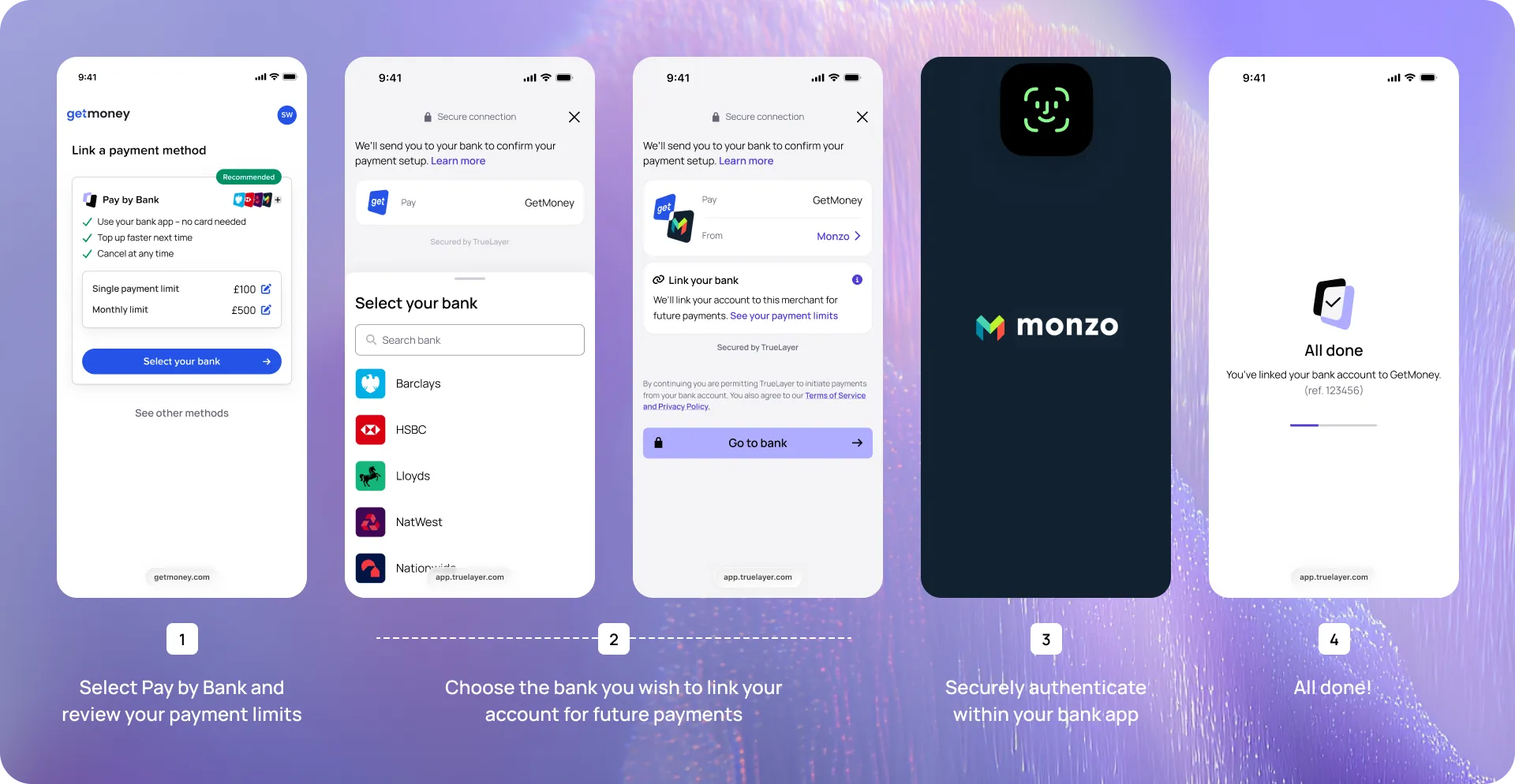
For consumers, cVRPs have an initial mandate creation, where they set up the mandate for future payments. This can be combined with the first payment. It looks like this:
Mandate set up and initial payment
The consumer chooses cVRP as their payment method of choice (for consumers this may have a name like Pay by Bank, so they understand exactly what they are choosing)
They define the mandate parameters, including the maximum amount per a specified period of time, and maximum amount per payment (the parameters can be pre-selected by the merchant)
The consumer selects their bank from the list available, and logs into their account using secure biometric authentication
They review and securely authenticate the mandate set up directly in their banking app
Finally, they are sent back to your website, where their completed payment and bank linking is confirmed instantly. If the set up included the first payment, the success notification will include confirmation of payment


Ongoing payments
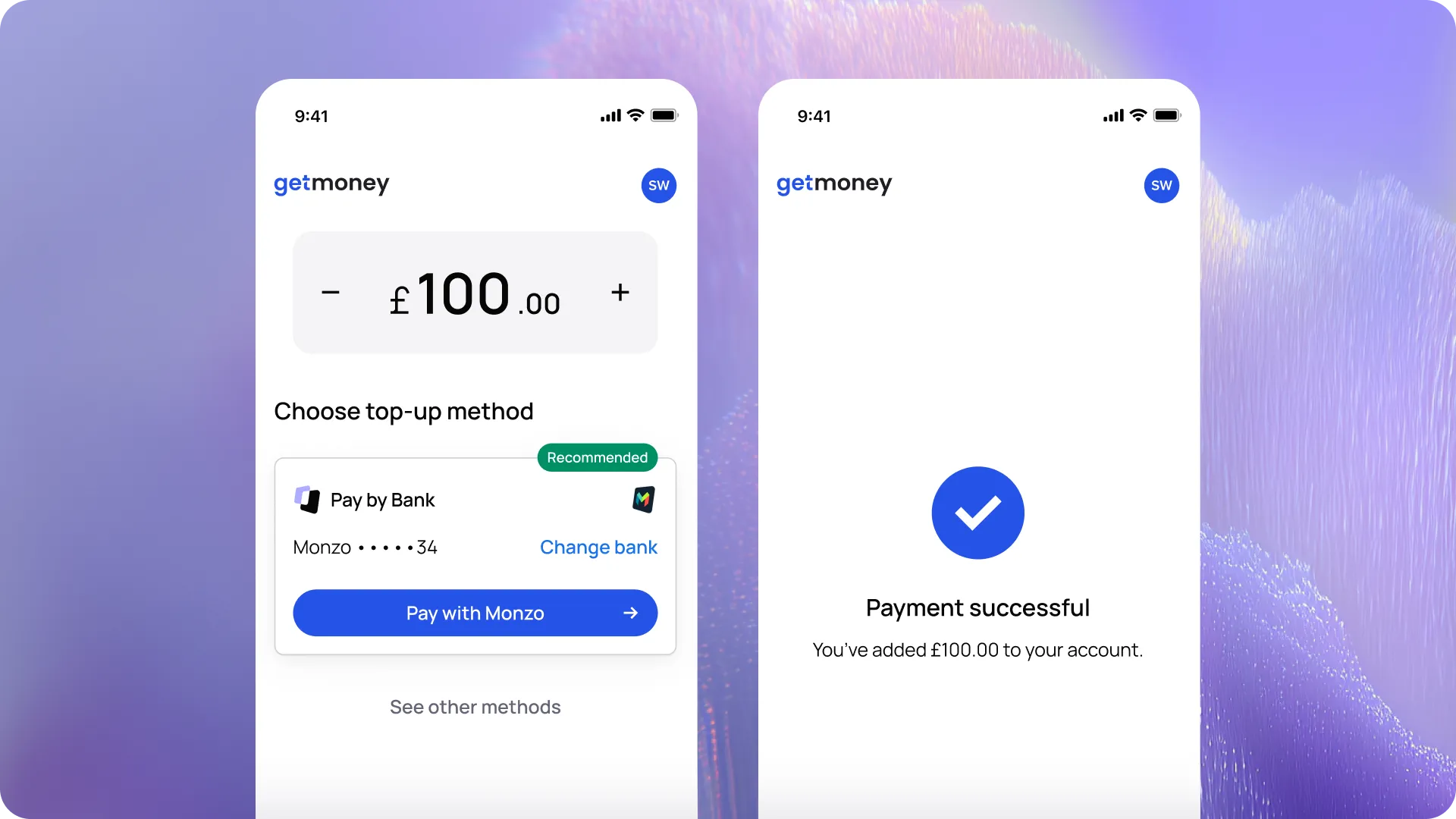
If ongoing payments are initiated by the merchant, such as energy payments, the consumer doesn’t have to take any action. As per the mandate, the money is collected from their bank account, and they are notified of any payments. If a payment is initiated by the consumer, such as ecommerce payments (planned for Wave 2), need just one click to make the payment.

What can cVRP be used for? And what other use cases are planned?
The UK Payments Initiative (UKPI) is rolling out cVRP to merchants in several phases, called ‘waves’. The UKPI is an independent, industry-owned and Government-endorsed company that was set up to own and operate the cVRP scheme, commercial model, and dispute framework. The UKPI is made up of 31 founding organisations, including TrueLayer, several high-street banks (including Barclays, HSBC, Natwest and more), challenger banks (like Monzo and Revolut) and several other payment providers.
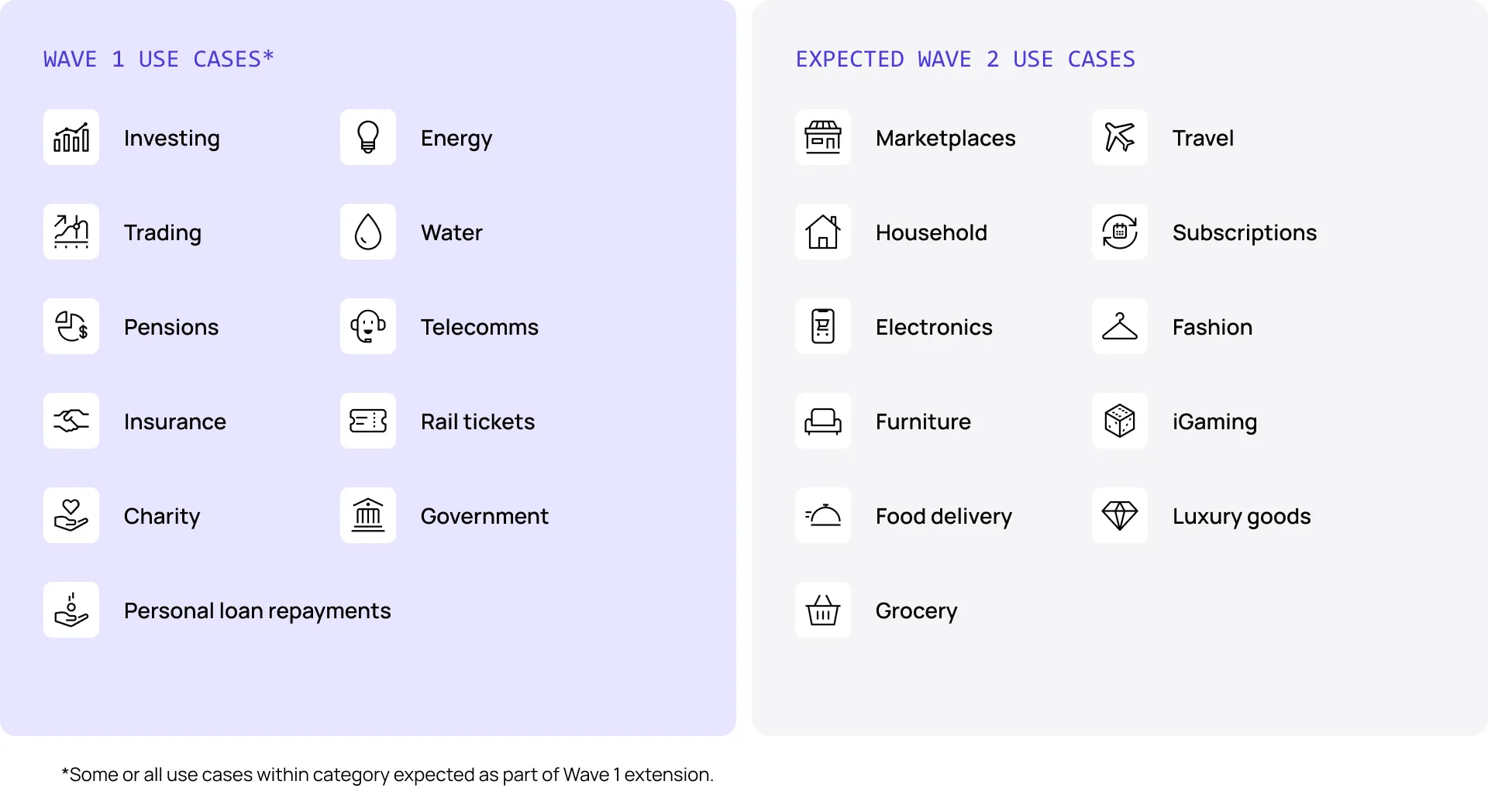
Wave 1 officially launched in June 2026, with the regulated financial services payments, Government payments and utilities payments all now available. A Wave 1 extension that covers some additional use cases is expected in late 2026 or early 2027.


Wave 1 use cases
Regulated financial services
Financial services firms that are eligible for Financial Services Compensation Scheme (FSCS) protection are in scope of Wave 1. It includes investing and trading platforms, where users can set up an ongoing funding arrangement — for regular top ups of varying amounts.
Pension providers granted master trust authorisation by The Pensions Regulator can also use cVRP for regular contributions and ad-hoc top ups. Mortgage providers regulated by the FCA, where cVRP can create seamless repayment (and overpayment) experiences is also included.
Car finance will be added in the Wave 1 extension, as will personal loan repayments.
Utilities & rail companies
Electricity and gas providers regulated by Ofgem can use cVRP for ongoing payments, as can water providers regulated by Ofwat. Ofcom-regulated providers of broadband and mobile phone services are also in scope.
Rail companies that fall under the National Rail Conditions of Travel can use cVRP for train ticket purchases and season ticket renewals are live. Third-party rail ticket retailers and distributors accredited by the Rail Delivery Group are in scope for the Wave 1 extension.
Government payments
UK government departments, local authorities and public bodies can use cVRP for the collection of taxes, fines, and council tax. Transport for London (TfL) can also use cVRP for services like the London Underground and buses.
Regulated rental payments, along with other similar property-related payments (ground rent, tenancy deposits, service charges etc.) are possible in Wave 1. This covers regulated social housing providers, along with letting agents, managing agents or property managers that are members of any government-approved redress scheme.
Charity payments
UK-registered and regulated charities can use cVRP for repeat donations. The Wave 1 extension will widen this to include fundraising platforms, as long as the donation is being made to a regulated charity.
E-money institutions
FCA-authorized EMIs for payments into a Payer's (or their family's) e-money account are in scope for cVRP.
Planned Wave 2 use cases
Wave 2 has not been finalised, but several use cases are likely to be in scope, subject to analysis and final confirmation, likely in late 2026. Wave 2 is expected to go live in 2027.
cVRP Wave 2 will include subscription payments, which means that subscription providers will be able to collect payments at the point their consumer subscribes and begins to use the service, something not currently possible with direct debit.
It will also include ecommerce payments, meaning we’ll see the first true one-click payment option that can rival card payments.
Food delivery platforms, supermarkets & grocery, electric vehicle (EV) charging and marketplaces are also likely to be in scope for Wave 2.
What are the business benefits of cVRP?
For merchants, cVRP is designed to combine the best parts of existing payment methods, like direct debit and card on file, while removing any gaps in functionality that negatively impact conversion, payment success and total cost of ownership.
Payment methods compared at-a-glance:
| cVRP | Direct Debit | Card-on-file | |
|---|---|---|---|
| Set up speed (time to first payment) | ✅ Instant | ❌ 6-10 days | ✅ Instant |
| Set up authentication | ✅ SCA (multi-factor authentication) | ❌ Paper/online form | ❌ Manual card entry |
| Settlement speed (ongoing payments) | ✅ Instant | ❌ Slow (usually 1–3 business days) | ❌ Varies, but up to three business days |
| User-defined limits | ✅ Flexible and visibile | ⚠️ Limited | ❌ None |
| Payment failure recovery | ✅ Same-day recovery logic possible | ⚠️ Dependent on ARUDD reporting cycle (with charges for failures and retries) | ✅ Possible via smart retries (PSP dependent) |
| Cancellation speed | ✅ Instant (in app) | ❌ 3+ days | ⚠️ Merchant-dependant (no consumer control) |
| Lifespan | ✅ Perpetual (subject to consumer control) | ✅ Perpetual | ⚠️ Limited (stops working if card is lost, stolen or expires) |
| Confirmation of funds | ✅ Yes | ❌ Not available | ❌ Not available |
There are several major benefits of cVRP that make it a complete recurring payment method:
Get unbeatable conversion rates
Thanks to the instant, simple mandate set up for consumers, alongside the one-click or completely invisible ongoing payment collection, cVRP has end-to-end conversion rates that are better than typical conversion rates of card payments, direct debit and the single immediate payments (SIP)side of Pay by Bank.
InvestEngine, one of the first brands to go live with cVRP, saw its ongoing conversion rate reach 98% with payments made using the payment method. The investment app also saw its key measure of success — assets under management (AUM) — increase after it rolled out cVRP to its customers.
"With that 98% conversion rate, the commercial impact on our business is very noticeable. It’s a significant uplift in terms of the ability for our clients to convert. From our perspective it just shows that the overall payment solution and payment journey that we're offering to our clients is what they need.” — Nick Øen, Head of Product for Payments, InvestEngine
Read the full InvestEngine case study
Reduce failed payments thanks to confirmation of funds
Confirmation of funds is a feature of cVRP that lets merchants check if their customer has sufficient funds in their account before attempting to collect a payment.
This insight allows merchants to react quickly to a notification of insufficient funds by reducing the collection amount to avoid payment failure and/or communicating with the borrower to add funds to their account. In turn, this leads to fewer payments that fail.
Confirmation of funds is supported by a wide range of UK banks and, importantly, is silent, meaning no additional stress on your customers caused by unnecessary notifications.
Merchants also get detailed information if a payment should fail, so you can implement recovery strategies to recover revenue more easily.
Get greater flexibility for variable payment amounts with consent parameters
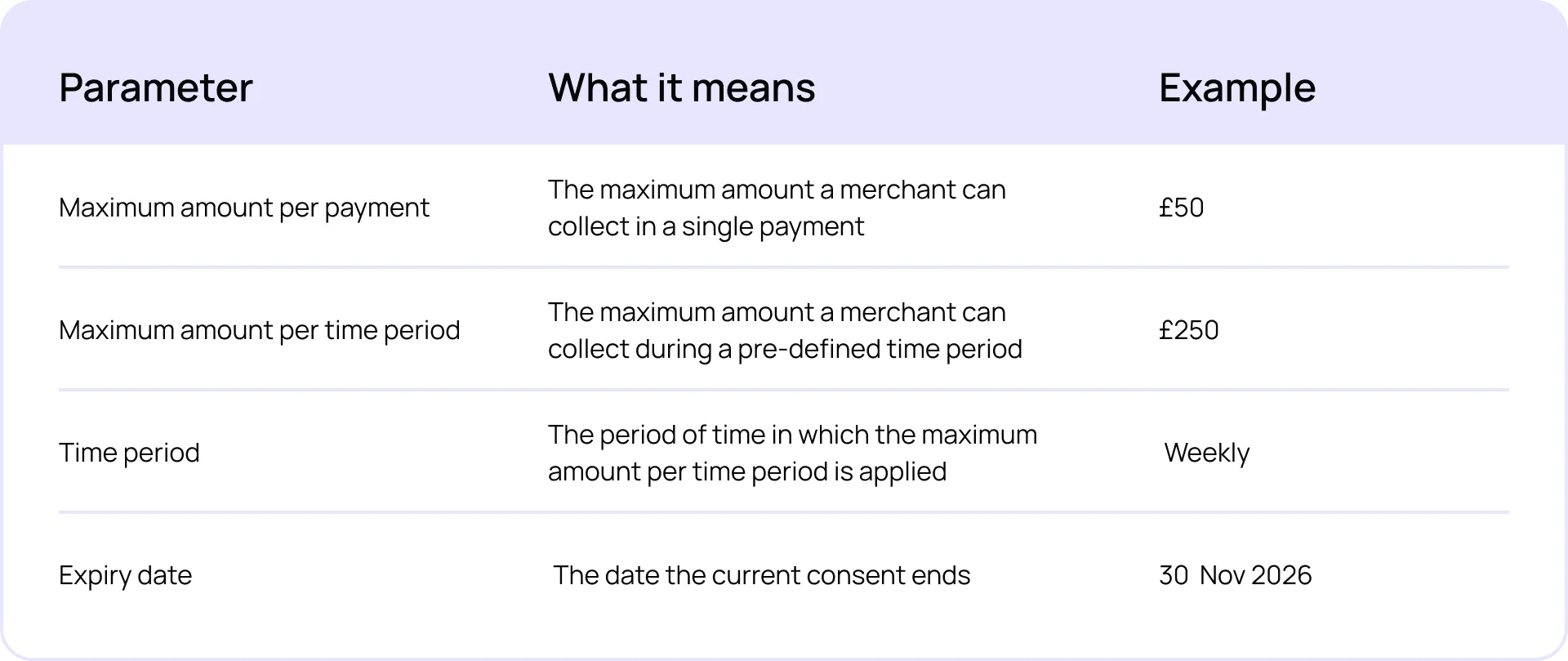
When a customer authorises a cVRP mandate, they agree to a set of payment-related limits. These consent parameters define the maximum amount of a single payment, the maximum total that can be collected in a given period (typically per month), and the validity window for the consent overall.
Within those parameters, you can collect without further customer involvement, giving you the flexibility to collect varying amounts at varying frequency.
Customers retain full control throughout. They can view the mandate, amend the parameters or cancel entirely, all through their bank app. That visibility is part of why cVRP tends to generate less customer friction than direct debit mandates that can appear opaque.


Instant settlement from the very first payment
Direct debit can take up to three days to settle because of the Bacs three-day cycle. Bacs payments aren’t processed on weekends, and UK bank holidays are also excluded. Direct debit also has a similar waiting time of three days when first setting up a mandate, meaning a potential 6+ day wait from setup to the first payment to settle.
cVRP, on the other hand, settles instantly, and once the mandate is set up using secure SCA, payments can be collected instantly as long as they fall within the consent parameters.
You can even combine setup and first payment into a single flow.
Lower operational costs
Beyond the simple transaction fee of any recurring payment method is a litany of potential operational costs, amplified when something goes wrong. For example, any failed payment needs retrying. And if you can’t recover that payment, it could eventually lead to involuntary churn, where a customer who wants to buy from you can’t, because their payment doesn’t complete.
For recurring card payments, chargebacks can also add considerable direct and indirect costs (and are also a vector for fraud). Direct debit payments have the direct debit guarantee, a consumer protection akin to chargebacks, which are also prone to friendly fraud, a type of chargeback when payers abuse the system for personal gain.
cVRP’s combination of low failure rates and strong authentication minimise these costs.
Will consumers use cVRP? What’s in it for them?
One of the biggest question marks of any new payment method is whether users will adopt and stick with a new payment method. VRPs, both sweeping and cVRP, already account for 7.7 million payments every month, up from 4.9 million 12 months previously. This shows consumers are happy to use it when it’s offered at checkout.
In addition to consumer benefits of all types of Pay by Bank payments, whether they are immediate single payments or recurring payments, cVRP has some unique features that make it particularly useful for your customers.
cVRP offers a level of visibility and control much greater than card-on-file or direct debit. They can set the parameters for any mandate, control payment timings, and amend or cancel mandates at any time. They will see the status and be able to make changes directly in cVRP dashboards in their banking app.
And confirmation of funds is a benefit for consumers as much as it is for merchants. If a consumer’s payment fails without their knowledge, then they’re more likely to lose access to important services.
At a time when FCA’s own research shows 7.4 million consumers feel burdened by bills and credit commitments, and 5.5 million have missed payments in the last six months, knowing they’re payments will complete successfully is an important prerequisite of a good payment method.
Is cVRP safe?
Yes, cVRP is a safe and secure payment method for consumers and for the merchants collecting the payments. cVRP is an open banking payment at its core. As part of open banking, providers access customer data through technology called application programming interfaces (APIs). They’re a proven technology designed to provide a secure connection between TPPs and customers’ accounts.
cVRP is significantly more secure than card on file. It doesn’t store raw bank account details. After the initial bank-level authentication, cVRP securely tokenises the details, meaning payments use a non-sensitive placeholder to facilitate future payments.
And when a customer chooses to pay a business using open banking, they don’t need to enter the payee details. Instead the provider pre-populates the details and controls where the money goes. This removes human error and the risk of customers being tricked into sending the money to a fraudster.
This approach, combined with strong customer authentication at setup, drastically reduces the risk of fraud compared to vulnerable card-not-present transactions.
When providers like TrueLayer enable payments for a merchant or other business, they enter into a commercial contract with that business and undertake due diligence on the business as part of that. This reduces the likelihood that bad actor merchants would use open banking to commit fraud.
How can I add cVRP to my checkout? Work with TrueLayer for Bank on File
cVRP is a live payment method that financial services businesses and utility providers can add to their payment experiences across several use cases, but the scope of it will continue to grow, including into ecommerce.
Whether your use case is live with Wave 1 and you’re looking for an early-mover advantage, or your use case will become possible in Wave 2 and you want to understand when and how to add it to your roadmap, TrueLayer can partner with you to deliver the best possible payment experience for you and your customers.
Why work with TrueLayer?
Input on the future of cVRP: TrueLayer is one of 31 founding PISPs in the VRP operator UKPI, directly shaping the future of recurring payments. Merchants using our Bank on File product have the opportunity to shape the next generation of recurring payments
Go to market fast: Work with our integration experts to build and launch your Bank on File
See real results, like our existing customers: InvestEngine uses TrueLayer’s Bank on File so its users can set up recurring deposits on its investment platform. It now sees 98% of all Bank on File payments complete successfully.
Get tried and tested playbooks for the best user experiences: TrueLayer has helped hundreds of enterprise merchants create high-performing Pay by Bank and Bank on File experiences. Make your new recurring payment journey one that your customers choose, time and time again.
Be an industry pioneer: The first cVRP payment experiences are live with the likes of Trading 212 and InvestEngine, but the next wave of merchants will still be among the early adopters at the cutting edge of this new payment method.
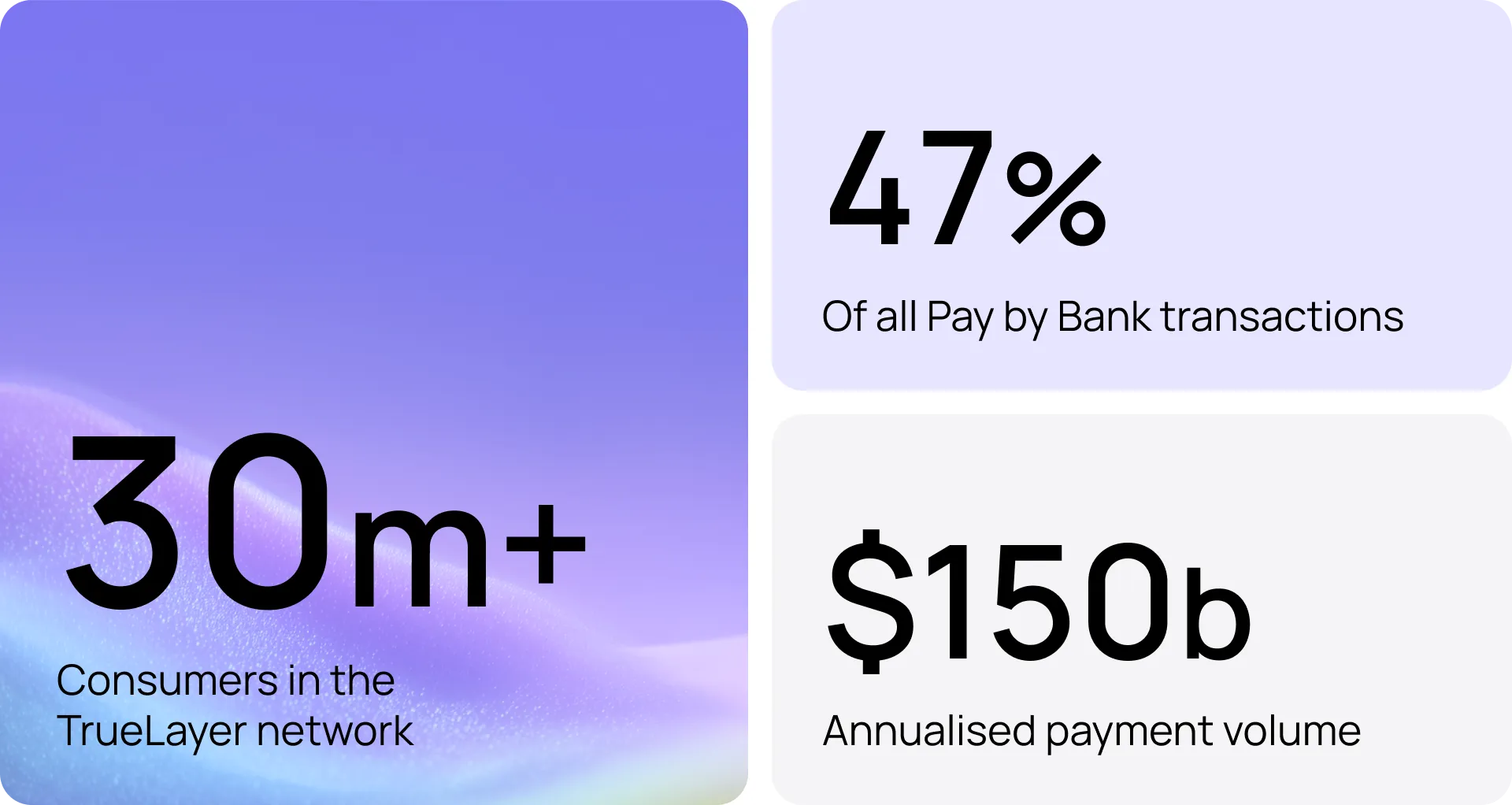
Europe’s leading Pay by Bank network: Access a rich universe of data, with over 30 million users primed and ready to pay using any kind of Pay by Bank payment.
To find out more about how TrueLayers’ Bank on File could help revolutionise your recurring payments, speak to one of our payment experts.


Key cVRP terms explained
VRP (Variable Recurring Payments): A payment method allowing businesses to collect recurring payments of varying amounts from a customer's bank account, with one upfront authorisation.
cVRP (Commercial VRP): Payments from a customer to a business. The type relevant to utility providers.
sVRP (Sweeping VRP): Payments between two accounts belonging to the same person. Already live and widely used. This is also known as sweeping or me-to-me payments.
Wave 1: The first phase of commercial VRP rollout, covering utilities, government, financial services and more. Launched June 2026.
Wave 2: The next phase of commercial VRP, expected in 2027. . This will likely include one-click payments and subscriptions.
UKPI (UK Payments Initiative): The 31-firm industry body, including all major UK retail banks, that operates the commercial VRP scheme.
Bank on File: TrueLayer's name for the customer-facing recurring payment experience built on VRP.
Mandate/consent: The customer's upfront authorisation of a cVRP arrangement, including all agreed consent parameters.
Confirmation of funds: The ability to verify a customer has sufficient balance before initiating a payment.
Faster Payments: The UK real-time payment infrastructure cVRP runs on, enabling instant settlement.


cVRP explained: get up to speed on commercial variable recurring payme

Italy's CDP Venture Capital invests in TrueLayer as Europe builds its