)


)
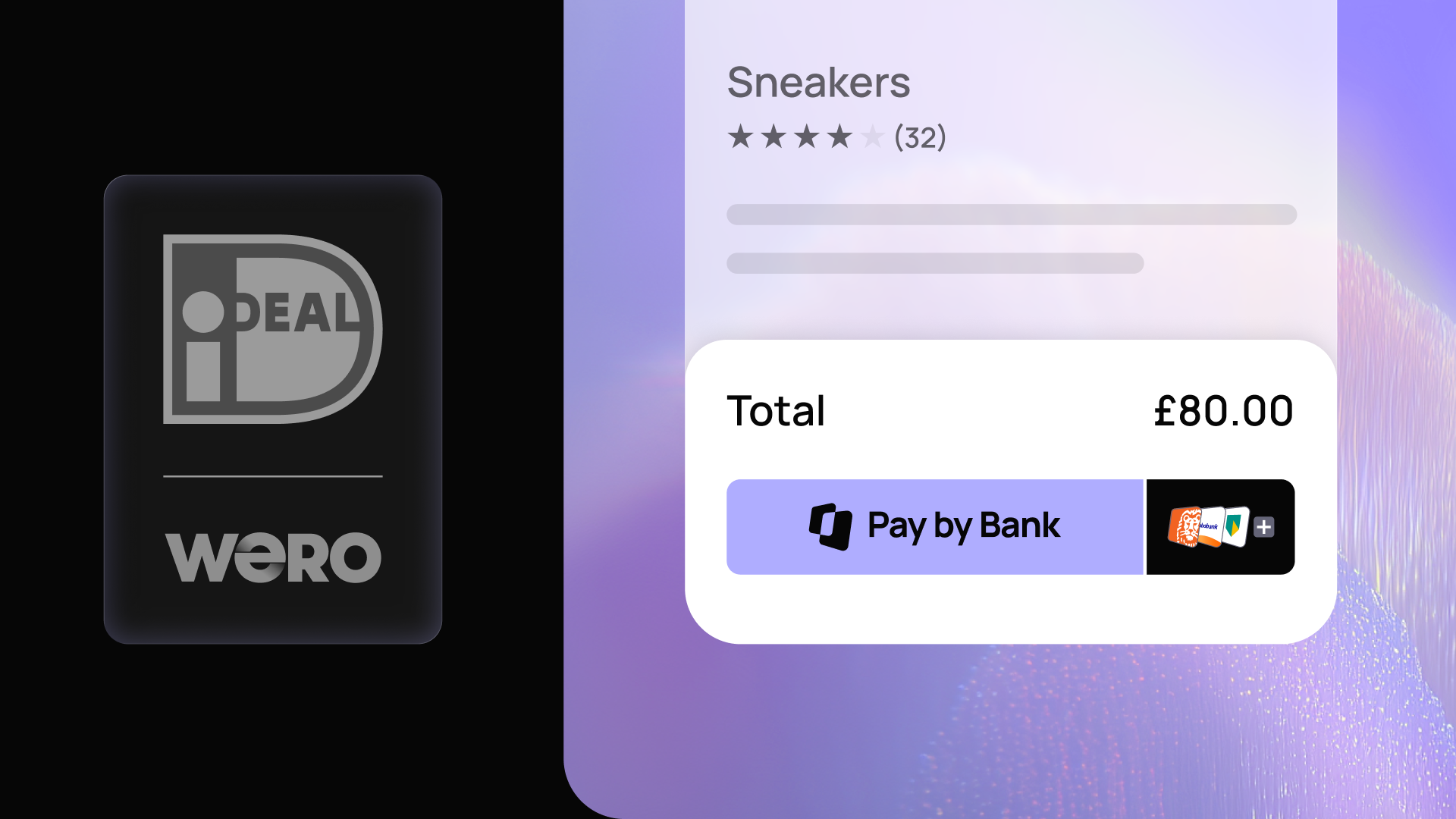
Whether you're based in the Netherlands or simply collecting payments there, you’ll be well aware of the ongoing shift from iDEAL, to the European payment solution Wero.
And merchants are being told three things as part of the transition story:
iDEAL to Wero is a simple technical migration. Complete your part and move on.
Wero will inevitably become the new payment system for Europe.
Merchants in countries affected have no alternative to adding Wero to their checkout.
And it's not hard to understand why Dutch merchants feel like it's a foregone conclusion. The mandated co-branding part of the migration took place earlier in 2026, with merchants facing iDEAL deactivation for non-compliance. Wero differs from iDEAL on pricing, consumer protections, data return and merchant control.
I want to use this article to give a fuller picture of iDEAL sunsetting, and the upcoming changes. Where will merchants benefit? Where will they suffer? And crucially, what alternative payment methods — that already exist — could be a better option for merchants in the Netherlands than simply defaulting to Wero.
Your iDEAL to Wero primer
The initial iDEAL/Wero co-branding has already taken place, but here's the important terminology, the timeline so far, and what's coming next, as condensed as I can make it:
What is iDEAL?
iDEAL is the Netherlands' dominant online payment method, with a market share of ~70% of all online payments. It’s an account to account (A2A) system that lets consumers pay directly from their bank account during checkout, rather than using a card. Despite its popularity, it is set to be decommissioned and replaced with Wero.
What is Wero?
Wero is a European digital wallet and instant payment scheme built by the European Payments Initiative (EPI), a consortium of several European banks. It allows consumers to both send and receive money from other individuals (P2P), as well as pay for things online.
Where is Wero available?
As of August 2026, Wero P2P is live in Germany, France, Belgium and some other European countries. Ecommerce payments are live in Germany and Belgium, with France coming soon. The Netherlands is mid-migration from iDEAL to Wero.
In terms of the iDEAL to Wero migration, what has happened so far?
So far, the focus has been on branding. As of 31 March 2026, all merchants collecting payments via iDEAL must have updated the iDEAL branding to include Wero co-branding. At checkouts, it is now referred to as iDEAL | Wero. The actual payment flow for shoppers will otherwise look the same.
And what happens next?
Starting at some point in Q4 2026, merchants will begin completing a gradual technical migration from iDEAL to Wero, at which point they will be able to collect payments using Wero.
Can't I just keep using iDEAL?
No. iDEAL will be fully phased out at some point in late 2027 or 2028.
Viewing iDEAL to Wero as a simple technical migration misunderstands what made iDEAL so popular
For readers outside of the Netherlands, it can be hard to understand how ingrained iDEAL is in everyday life. With nine in ten online shoppers using it for online payments each year, and a 70% market share of online commerce payments, it holds a near monopoly.
For shoppers, the simplicity of iDEAL with no need for a card or third-party app, combined with instant settlement, meant it quickly became a nationwide habit. And very low fraud, combined with the backing of national banks, helped cement trust in the system.
As market share exceeded 70%, not offering iDEAL wasn't really an option for merchants. But thanks to high conversion rates, a simple dispute mechanism free from chargebacks, and two-factor authentication (2FA), it was an easy decision to make regardless.
So, while the narrative of the iDEAL to Wero shift has been one of a simple technical switch, the two payment methods are more different than you might think.
What changes when Wero takes over?
While Wero is still an account to account payment system that allows customers to pay for things online, and funds still settle instantly, there are several differences between the two payment options. This means a big shift in cost structure, risk profile and commercial control.
A pan-European ambition
Wero aims to be pan-European. It's currently available in Germany, France, Belgium and more, with EPI's ambitions running continent-wide. This is in part a desire to make Europe less reliant on non-European payment systems.
A completely different pricing model
iDEAL has given merchants selling in the Netherlands some of the lowest payment costs in Europe. Wero abruptly ends that. Wero replaces iDEAL's predictable flat fee with ad valorem (percentage-based) pricing.
For merchants, this is a complete structural cost change. Not only would your costs increase as you grow and take more payments, but they would accelerate. For any scaling or growing business, this new model could mean a sharp increase in payment fees.
The uncertainty of chargebacks and consumer protections
Today, Dutch merchants use iDEAL with virtually zero chargebacks. iDEAL handles disputes via a strong direct consumer-to-merchant relationship, as well as parallel consumer protections that sit outside the payment rails.
Wero has introduced card-like chargeback-style mechanism as a feature in the countries it has already launched in.
Chargebacks introduce chargeback fees (even if you successfully dispute the chargeback), and every chargeback is a sale reversed. Aside from the direct financial hit, managing chargebacks means a whole new operational overhead for a payment method that has not had to deal with this until now. With every chargeback taking about 20 minutes to investigate and resolve, that quickly becomes an entire department of people.
In the Netherlands, Wero has yet to confirm if it will use the same chargeback mechanism, or how this fits into its multi-market approach to consumer protections and dispute frameworks.
This lack of clarity makes it difficult for merchants on iDEAL to understand how much their current approach to payments will need to change, and whether they’ll need to invest further in headcount to manage any new chargeback mechanism.
Less leverage, less control
iDEAL is run by a Dutch bank consortium, a single-country governance body. Dutch merchants and their local PSPs had a fairly direct relationship with rule-setting that reflected Dutch market norms specifically.
Under Wero, EPI sets rules at a pan-European level, not a Dutch one. EPI's founding banks (BNP Paribas, Deutsche Bank, BPCE, ING and others) negotiate fee structures, dispute requirements and scheme rules across multiple countries.
Dutch merchants' interests carry less weight than they did under iDEAL's Dutch bank consortium.
Pay by Bank: the IDEAL alternative you might have overlooked
Whatever the pros and cons of Wero, merchants have no choice: iDEAL is being decommissioned.
You can't keep iDEAL, but alternatives exist that offer the same bank-backed account to account experience your consumers recognise and trust. Pay by Bank is the most direct alternative.
Pay by Bank lets customers pay directly from their bank account via their bank app, without the need for card networks, plus other benefits that make it stand out from both iDEAL and Wero.
The experience shoppers expect: While iDEAL became a mainstay brand in the Netherlands, it's the simplicity of the payment flow and the implicit trust consumers have in their banks that made the iDEAL brand so sticky. Pay by Bank works in much the same way, using the customer's bank app to authenticate the payment.
Dutch consumers pay using an A2A payment method. Whether it says iDEAL above the button is largely incidental.
The best parts of iDEAL and functionality beyond: Pay by Bank also goes well beyond just pay ins. Providers like TrueLayer also offer instant refunds, data insights and user verification that make shoppers more likely to try it, and gives merchants better tools for building high-performing payment experiences.
No chargeback mechanism: There is no chargeback mechanism with Pay by Bank. That means no additional headcount, no fees for disputes that you are not responsible for, and no chargeback fraud to deal with.
Predictable fees: And as Pay by Bank is a technology, not a payment scheme, there are no consortium-set fee changes. Pay by Bank gives you pricing clarity. The cost of a payment doesn't grow just because your business does.
Pan-European payments: TrueLayer is already processing account to account (A2A) pay-ins in the Netherlands, Belgium, France, Germany, all through the same integration. For merchants with cross-border European operations, a single Pay by Bank integration covers multiple markets, without Wero's country-by-country rollout complexity or its variable fee structure.
And thanks to our coverage across major European markets (often 95% or above), with no requirements for consumers to download any apps or go through any additional sign up process.
What this means for your checkout strategy now
The question worth asking now isn't "when do we migrate to Wero?" It's "which payment method best serves our business after iDEAL?"
For many merchants selling in the Netherlands, Pay by Bank will be the cleaner answer: the same bank-based consumer behaviour, no chargeback liability, flat-fee pricing and no wallet enrolment dependency.
For others, running Pay by Bank alongside Wero may make sense, particularly where cross-border wallet functionality matters to their customer base. Those two approaches aren't mutually exclusive.
Treating this migration as a straight swap won't work. Wero is a legitimate European payments initiative with genuine long-term ambition. But it's a card-like product, built on card-like economics and a card-like risk model. Merchants who migrate assuming they're getting an iDEAL replacement will find the numbers don't match what they had before.
Pay by Bank preserves what made iDEAL work for merchants: no chargebacks, flat-fee pricing, direct bank payments, instant confirmation. It's live in the Netherlands, it converts and it's growing. If you're evaluating post-iDEAL payment options, explore it before the default path decides for you.
)

Chargebacks: the wrong design choice for Pay by Bank
)
Our response to the Future Retail Payments Infrastructure consultation
)