
)


)
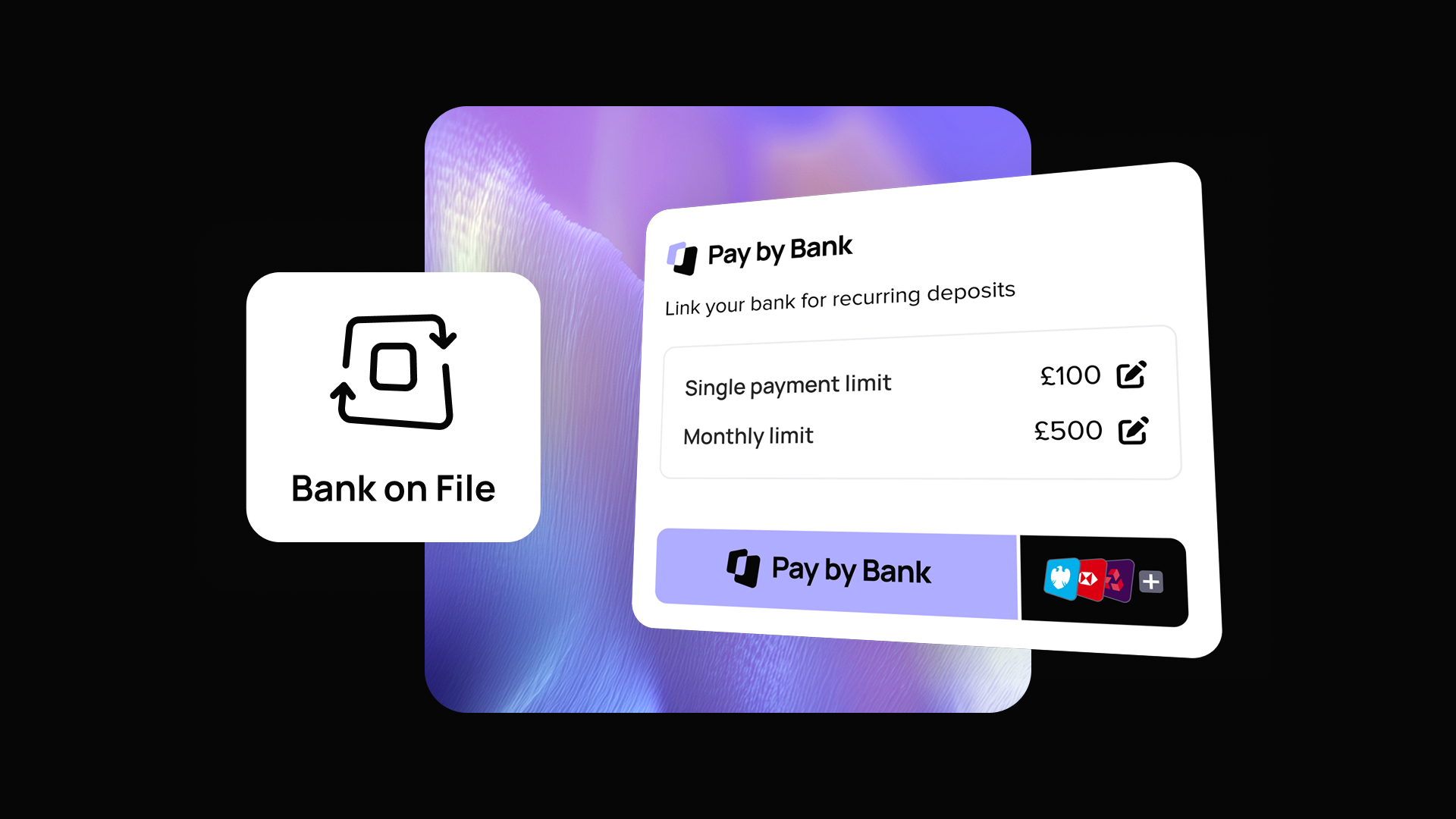
Saving a bank account for future payments should be as simple as saving a card. For years it hasn't been, because the infrastructure simply didn't exist.
That changed when the UK's commercial variable recurring payments (cVRP) framework opened up a few weeks ago, but we didn't build a cVRP product.
We built Bank on File: a product that hides the complexity of payment rails entirely, and gives merchants and their customers something they've actually been waiting for.
What does this mean in practice?
Our new Bank on File product lets users save their bank accounts with a merchant, so that future payments are one-click or even invisibly taken in the background (for example: for your electricity bill or a subscription).
If card on file is the mechanism for taking repeat or recurring payments on card, then Bank on File does the equivalent for Pay by Bank. But Bank on File comes without the downsides of card payments: no need to dig through pockets to find card details for the first payment, and no need to renew them when the card is lost or expires. Bank on File links directly to your underlying bank account. It can be set up with just a few taps and a biometric authentication in your bank’s mobile app as part of first payment.
User experience is everything: Less jargon, more plain English
Let’s get into specifics of how Bank on File goes beyond basic payment rails. First, our Design team have crafted a beautiful user experience within TrueLayer’s user interfaces, taking on all the learnings from our position as market leader for sweeping variable recurring payments.
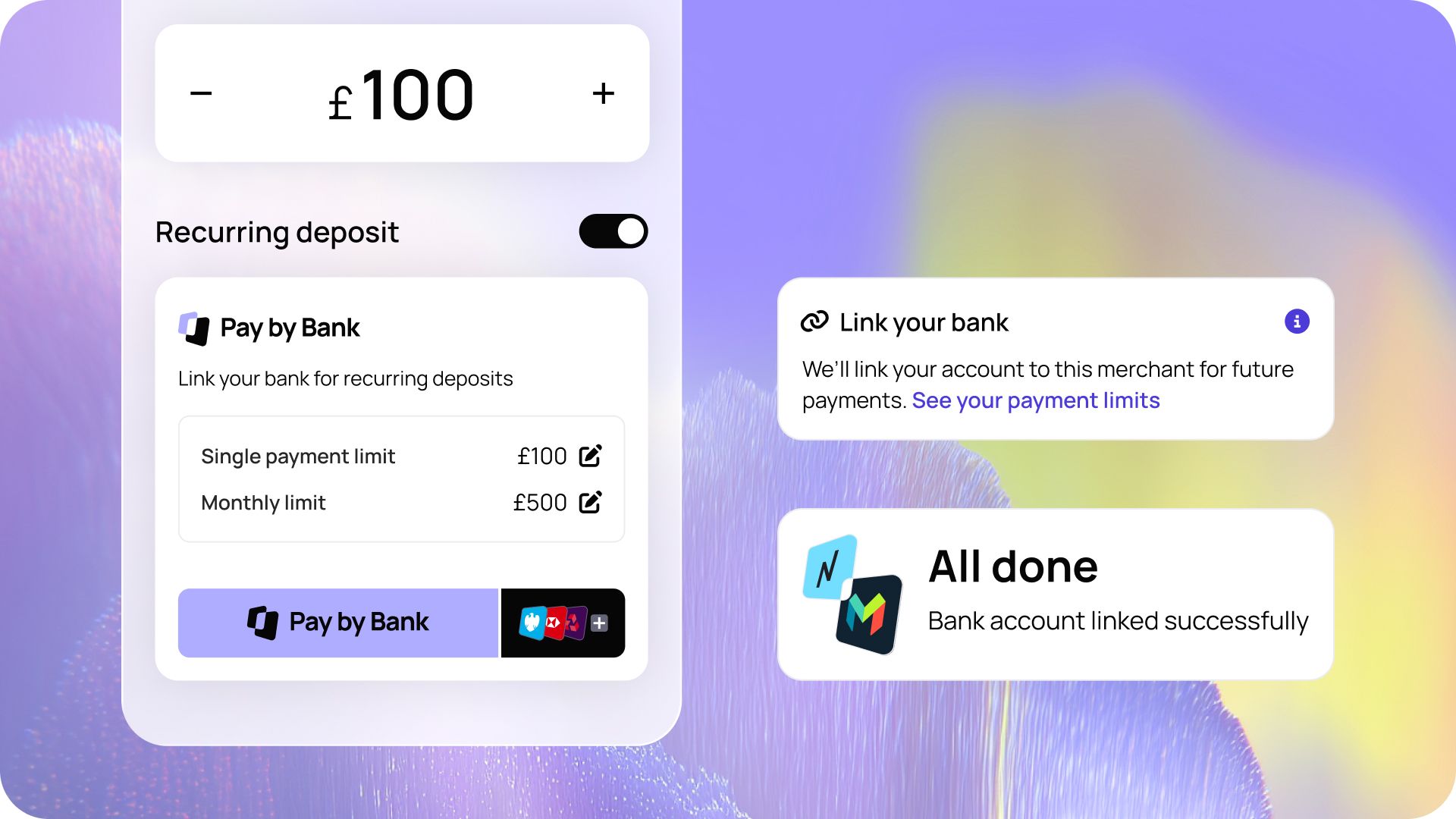
We’ve also been thinking carefully about the language of payments. For example, both the new cVRP and traditional recurring account to account methods like Direct Debit have the concept of a mandate that the user grants their consent to establish. This doesn’t make a lot of sense to the average person. So we’ve put this into human terms, asking the user instead to link their bank account for future payments.
)
Putting flexibility and control at the heart of the product
As well as one-click checkout, Bank on File supports fixed regular payments. Again, we’ve humanised this: the focus is the amount the user wants to pay, so they can get on with the task they actually care about. Yet, they have flexibility to change the details for future payments if they need to, with one extra click. The user has full control over the payment method, but we don’t mention the idea of constraints or other financial jargon that the user could easily misinterpret or misunderstand.
“As important as the language and visuals that a user does see when using Bank on file, the details that they don’t see are equally as important. We’ve deliberately stripped unnecessary complexities away.
As important as the language and visuals that a user does see when using Bank on File, the details that they don’t see are equally as important. We’ve deliberately stripped them away. For example, the cVRP payment rail requires the concepts like ‘use case’ and ‘interaction states’ to be shared with banks (or Account Servicing Payment Service Provider) with each payment to ensure that the payment is in line with regulatory requirements. We follow that requirement, of course, but none of this is visible to the user. In typical TrueLayer fashion, we also abstract away as much of this as possible from the merchant’s integration.
Built to scale: Bank on File perfectly dovetails with Pay by Bank
Crucially, our orchestration across payment rails takes TrueLayer’s Bank on File product beyond what’s been mandated for the industry. Through our unified Payments API, merchants have the flexibility to opt for a single payment or recurring, and our in-house risk engine (fine-tuned across millions of payments in the UK and EU) can support with decisioning here, too.
So we’ve built this product to scale, in multiple ways: volumes, use cases, branding at checkout. Our orchestrated approach means we can wrap everything under one brand: Pay by Bank, building on the familiarity consumers have with this. And of course, we already process the majority of variable recurring payments in the UK, so we’re used to handling massive transaction volumes.
This is just a first look at Bank on File. We’ll be sharing a lot more on our latest product, as we continue our close work with major UK banks and UKPI to bring about the next evolution of payments. If you want to find out more, speak to one of our payment experts.
)

Italy's CDP Venture Capital invests in TrueLayer as Europe builds its
)

TrueLayer and SumUp partner to simplify account top-ups across Europe
)
